Uzbekistan and Russia are the two destinations most often shortlisted together by Indian families — and no wonder: they share a medical teaching tradition, a government-university model and a similar price philosophy. But they are not interchangeable, and the differences that matter live in the details agents skip. Zenvia Education counsels for both Uzbekistan and Russia, so here is the comparison with no thumb on the scale.
Cost: Twins at the Budget End, Divergent Above It
| Head | Uzbekistan | Russia |
|---|
| Tuition / year | ₹2.5 – 5 Lakhs | ₹3 – 8 Lakhs |
| Living / month | ₹8,000 – 14,000 | ₹12,000 – 20,000 |
| Flight home (one way) | ₹15,000 – 30,000 (3 hrs direct) | ₹25,000 – 60,000 (often 8+ hrs) |
| Six-year all-in | ₹20 – 35 Lakhs | ₹25 – 55 Lakhs |
At the entry tier the two overlap, but Uzbekistan's living costs and airfare consistently undercut Russia's — and over six years, those "small" lines compound into several lakhs. The complete Uzbek numbers are in our fee breakdown.
University Depth: Russia's Strongest Card
Honesty first: Russia's bench is deeper. It has dozens of medical universities with global name recognition and century-old research pedigrees; Uzbekistan has a handful of solid government institutions — Tashkent State, Samarkand, Andijan and their peers — that are respected regionally rather than famous globally. If institutional prestige is a decision driver for your family, Russia's top tier wins. If what you need is a well-run government university that produces FMGE-ready graduates at the lowest workable cost, the prestige gap matters far less than agents on either side pretend.
Climate and Distance: Uzbekistan's Strongest Card
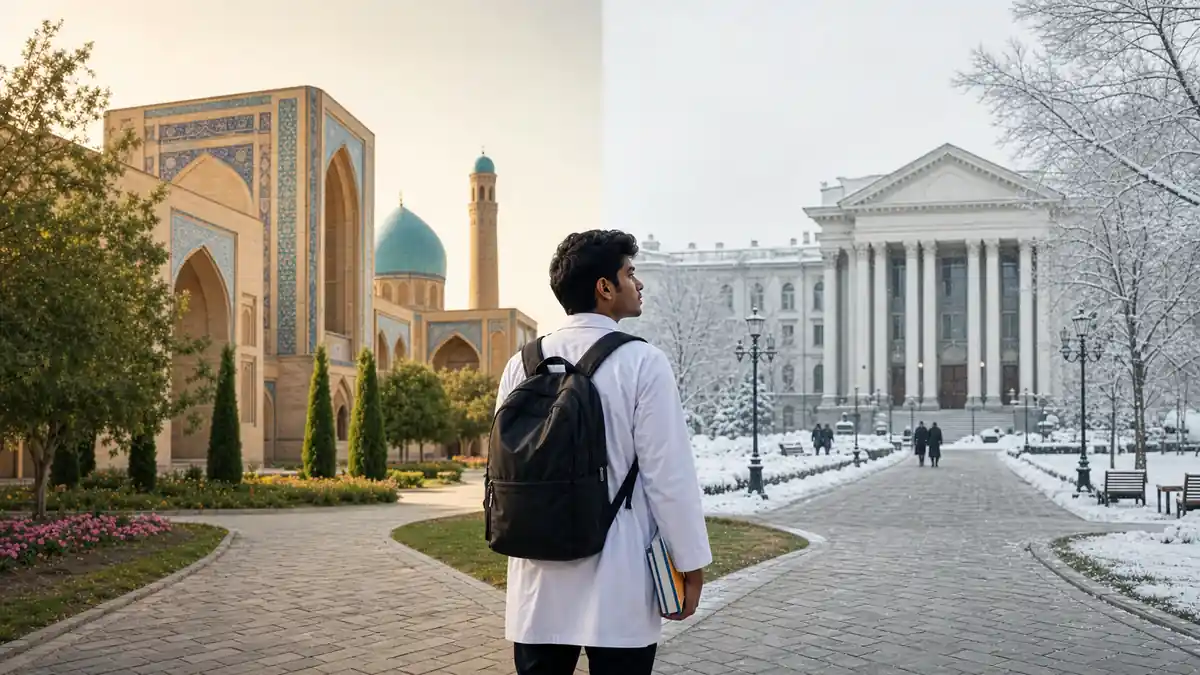
Tashkent is roughly three direct flying hours from Delhi; much of Russia is a day of travel with connections. Uzbek winters are cold but short and manageable; Russian winters in most university cities are five months of serious sub-zero. For homesick first-years, for parents who want to visit, and for medical emergencies at home, proximity is not a soft factor — it changes how the six years feel. Culturally, Uzbekistan's familiarity (food, warmth toward Indians, Bollywood fluency) shortens the settling-in period noticeably.
Language of Instruction
Both countries teach international students in English and both require local-language skills for clinical years — Russian there, Uzbek/Russian here. The practical difference: in Uzbekistan, Russian remains widely spoken in hospitals, so students effectively gain the same clinical Russian that Russia demands, while daily life runs in a language environment that many Indians find easier to navigate. Neither country lets you skip the language work; do not believe any pitch that says otherwise.
Admission Speed and Flexibility
Uzbekistan runs the fastest admission cycle in the region — document-based selection, offers in days, and a predictable invitation-letter pipeline, as detailed in our admission guide. Russia's process is also forgiving but slower end-to-end, with more variance between universities. For students starting late after NEET results, Uzbekistan's speed frequently rescues a September intake that Russia's timeline would miss.
FMGE/NExT Outcomes
Both produce NMC-eligible graduates when the rules are followed — NEET before joining, one WDOMS-listed university start to finish, internship included. FMGE results from both countries track the same two variables everywhere: the university's clinical exposure and the student's preparation discipline. Neither flag confers an advantage in the exam hall; a serious student at Samarkand and a serious student at a Russian government university walk into FMGE on equal footing. Compliance details are in our Uzbekistan validity guide.
Daily Life: Two Different Six-Year Experiences
Beyond the spreadsheets, the two countries simply feel different. Russia offers the big-institution experience: sprawling campuses, formidable professors, large and long-established Indian communities in cities like Kazan and Volgograd, and the character-building rite of a real Russian winter. Uzbekistan offers something closer to home: bazaars that smell like Indian markets, hosts who treat students as guests, food that adapts easily to Indian palates, and the psychological safety of knowing home is three hours away. Neither is objectively better — a student who thrives on independence and scale will love Russia; one who settles faster with familiarity and warmth will do their best work in Samarkand or Tashkent. Six years is long enough that this fit genuinely affects academic outcomes; weigh it as seriously as the fee table.
Count the Whole Journey, Not Just the Degree
Whichever country you choose, the MBBS is not the last bill: FMGE/NExT coaching after returning (₹1 – 2 Lakhs for serious programmes), the licensing gap months when the graduate studies rather than earns, and postgraduate preparation after that. Uzbekistan's lower six-year total leaves the most headroom for this second phase of the journey — a structural advantage for middle-class families that rarely appears in country comparisons but shapes how stressful year seven feels.
The Verdict by Profile
- Budget ₹20 – 30 Lakhs, want lowest total cost: Uzbekistan — same government-university model, cheaper living, cheaper flights.
- Prestige-driven, budget ₹35 Lakhs+: Russia's famous flagships justify their premium for you.
- Late applicant racing the intake: Uzbekistan's speed wins.
- Family that will visit often / anxious first-time flyer: Uzbekistan's three-hour proximity is decisive.
- Comfortable with hard winters and long travel for a bigger name: Russia.
Frequently Asked Questions
Is Uzbekistan's degree weaker than Russia's for NMC?
No — NMC eligibility is rule-based (WDOMS listing, course structure, NEET), not country-ranked. Both qualify identically when rules are followed.
Which country is safer for Indian students?
Both are safe in university cities. Uzbekistan's smaller cities are notably calm; standard big-city awareness applies in both.
Which is better for USMLE ambitions?
Both are WDOMS-listed and ECFMG-eligible. For seriously global ambitions, also weigh Turkey, whose institutional standing travels furthest.
Can I compare exact universities side by side?
Yes — use the comparison tool, or ask us to run your shortlist: book a free session.
Which country has the easier admission process?
Uzbekistan, measurably — document-based offers within two weeks and a predictable invitation-letter pipeline, versus Russia's slower, more variable timelines. For late applicants this difference alone often decides the intake year.
Are living costs really that different?
Over six years, yes: Uzbekistan's ₹8,000 – 14,000 monthly living band versus Russia's ₹12,000 – 20,000, plus cheaper flights home, compounds to a gap of ₹4 – 8 Lakhs across the course.
Do both countries require learning a local language?
Both require clinical-level local language skills by the hospital years — Russian there, Uzbek/Russian here. Universities teach it as part of the programme; students who take those classes seriously in years one and two coast through the wards later.
A Note on Information Freshness
One final habit worth building: both countries adjust fees, intake quotas and visa procedures between academic years, and 2026's numbers will not be 2028's. Whatever you read — including this article — treat published figures as the map, not the territory, and confirm against current official documents before money moves. This is equally true of glowing YouTube testimonials (often a batch or two old) and alarming forum posts (often about a rule that has since changed). The families who decide well are the ones who verify in the final month before paying, not the ones who researched hardest two years earlier.
Still torn between the two? This is the single most common dilemma we counsel on, and it usually resolves in one conversation once the family's real budget and temperament are on the table. Book a free counselling session or contact us — and read the complete Uzbekistan guide and university comparison before you decide.