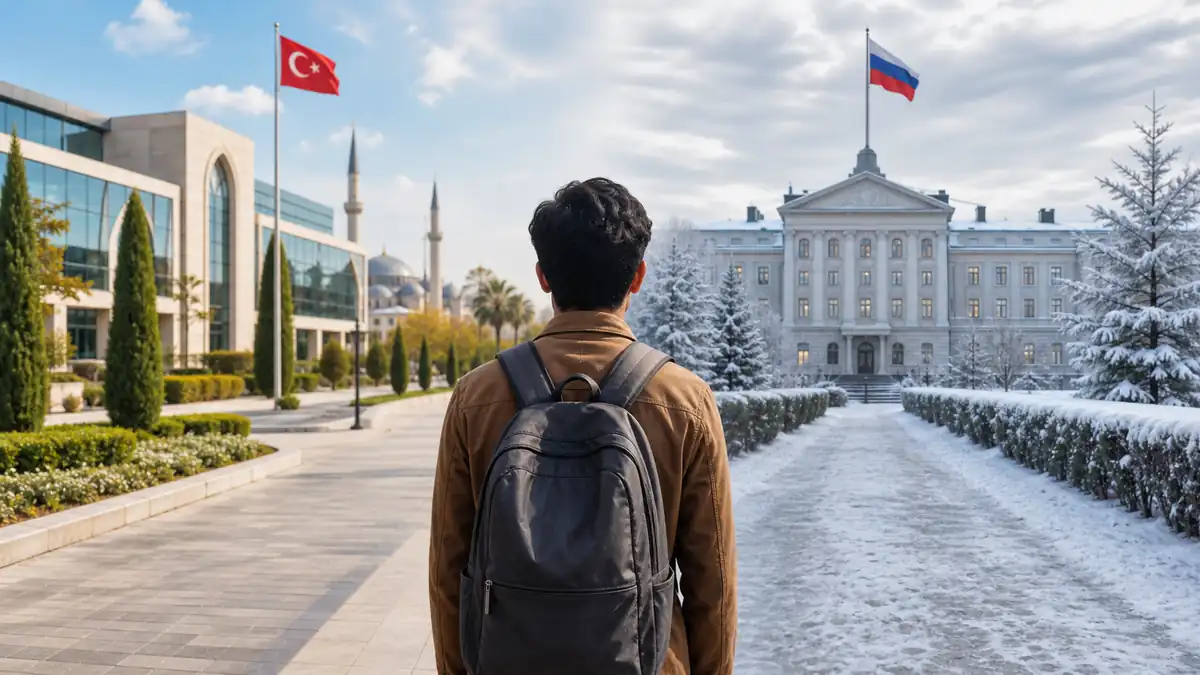
Turkey and Russia sit at opposite ends of the most common dilemma Indian families face when planning MBBS abroad: Russia is the established, budget-friendly veteran; Turkey is the newer, higher-priced, higher-polish contender. Both produce NMC-eligible doctors. So which one deserves your six years? Here is the honest, line-by-line comparison — no destination bias, because Zenvia Education counsels for Turkey and Russia alike.
Cost: Russia Wins on Budget, Turkey on Range
| Head | Russia | Turkey |
|---|
| Tuition / year | ₹3 – 8 Lakhs | ₹4 – 12.5 Lakhs (public) / ₹12.5 – 23 Lakhs (private) |
| Living / month | ₹12,000 – 20,000 | ₹15,000 – 30,000 |
| Six-year all-in | ₹25 – 55 Lakhs | ₹35 Lakhs – 1.4 Crore |
For a family with a hard ceiling around ₹30 Lakhs, Russia's government universities are the realistic answer, and it is not close. Turkey only competes on price if you win a public-university seat through YÖS — possible, but not a plan you can bank on. Full rupee details are in our Turkey fee breakdown.
Quality and Infrastructure
Russia's top government medical universities are genuinely strong, with a century of medical teaching tradition. But the tier spread is wide, and infrastructure at mid-tier institutions can feel dated. Turkey's leading faculties — Hacettepe, Istanbul University — and modern private players like Medipol operate at a visibly higher infrastructure standard: newer hospitals, simulation centres, and stronger international research links. If you are paying private-tier money, Turkey delivers a private-tier experience.
Language of Instruction — Read This Twice
This is the most under-weighted factor in the whole decision. In Russia, many "English-medium" programmes shift heavily toward Russian in the clinical years, because patients speak Russian — students must learn the language to take histories. In Turkey, the top international programmes are genuinely English-medium, but you will still learn conversational Turkish for patient interaction. Neither country lets you escape a local language entirely; Turkey's English-medium delivery is, on balance, more consistent at the universities Indian students join.
Climate and Daily Life
Russian winters are long and harsh — months of sub-zero temperatures in most university cities. Turkey's climate is far kinder: Istanbul winters are mild, closer to a North Indian winter than a Siberian one. Food-wise, both countries are manageable for vegetarians with self-cooking, but Indian groceries and restaurants are easier to find in Istanbul. Flight connectivity also favours Turkey: direct Istanbul flights from Delhi and Mumbai versus longer routes to many Russian cities.
Admission Difficulty and Timeline
Russia is the more forgiving admission process: direct admission on 12th marks plus NEET at most universities, generous deadlines, high acceptance predictability. Turkey's private universities are similarly direct (marks + NEET), but its public universities demand YÖS/SAT preparation, and good programmes close their international quota early — the sequencing is covered in our Turkey admission guide. If you are starting late in the cycle, Russia tolerates it; Turkey punishes it.
Licensing Outcomes: FMGE/NExT and Beyond
Both countries' degrees are NMC-eligible when you follow the rules (NEET before joining, full on-campus course, internship). FMGE outcomes vary far more by university and student discipline than by country — a serious student at a strong university clears from either. Where Turkey pulls ahead is the international option value: its universities' global standing and English-medium depth make USMLE and European pathways more natural. If your plan is strictly "return and practise in India", that advantage matters less; our NMC recognition guide covers the India-return path in detail.
Total Cost of Becoming a Doctor — Not Just the Degree
One line families often miss: the MBBS is not the final bill in either country. Add FMGE/NExT coaching after returning (₹1 – 2 Lakhs for serious programmes), the months between graduation and licensing when the graduate is studying rather than earning, and postgraduate preparation after that. On this whole-journey view, Russia's lower degree cost leaves more headroom for the licensing and PG phase — a genuine advantage for tighter budgets — while Turkey's stronger clinical foundation can shorten the struggle for students who use it well. Budget for the doctor, not just the degree, and the right country often becomes obvious.
What Six Years Actually Feel Like — Students' Own Words
Numbers decide the shortlist, but daily life decides whether the six years are happy ones. Our Russia students talk about tight-knit Indian communities (some universities host hundreds of Indian students), predictable routines, and winters that genuinely test you — the first November is hard, the second is normal. Our Turkey students talk about the energy of Istanbul, hospitals that feel like the modern facilities they saw in brochures, and the surprise of how quickly basic Turkish comes. Homesickness hits both groups equally; the cure in both countries is the same — seniors, festivals celebrated together, and a direct flight home each summer. Neither country wins this section; they simply suit different temperaments. A student who wants a large Indian bubble will settle faster in Russia; one who wants a more international, big-city experience will prefer Turkey.
The Mistake That Costs More Than Either Country: Choosing on Fear or Hype
Every year we meet two kinds of mis-matched students. The first stretched the family into a premium Turkish private seat because "Europe sounds better", is now anxious about money every semester, and would have thrived at a strong Russian government university at half the cost. The second squeezed into the cheapest seat they could find anywhere, discovered the university's clinical exposure was thin, and now faces FMGE preparation with weak fundamentals. Both mistakes were avoidable with one honest, numbers-first conversation before admission. Whichever way you lean after this article, pressure-test the decision against your NEET score, your family's comfortable budget (not the maximum loan), and your licensing plan.
Frequently Asked Questions
Which is cheaper overall — Turkey or Russia?
Russia, in almost every realistic scenario. Only a YÖS-won Turkish public seat brings the two close, and even then Russian living costs are usually lower.
Which country's degree is better for settling abroad?
Both are WDOMS-listed and USMLE-eligible, but Turkey's stronger institutional rankings and consistent English-medium delivery give it the practical edge for US/European ambitions.
Is the FMGE pass rate better from Turkey or Russia?
Neither country has a magic pass rate — outcomes track the university's clinical training and the student's preparation discipline far more than the flag on the campus. Pick the strongest university your budget honestly affords, in either country.
Can I switch from Russia to Turkey (or back) mid-course?
Mid-course transfers between countries are a serious NMC-compliance risk and almost never advisable. Make the country decision once, properly, before you fly.
The Verdict by Profile
- Budget under ₹30 Lakhs: Russia, without hesitation. Also compare Uzbekistan and Kyrgyzstan at this level.
- Budget ₹40 Lakhs – 1 Crore, strong academics: Turkey — try for a public seat, keep Altınbaş-tier private as backup.
- USMLE / global ambitions: Turkey's top faculties give you the stronger platform.
- Late applicant (June onwards): Russia's timelines are more forgiving.
Still torn? Put both side by side on our country comparison tool, or skip straight to a human answer: book a free counselling session and Zenvia Education will map your NEET score, budget and goals to a specific recommendation — country, university and intake. You can also contact us for current-year seat availability, or dive deeper with the complete Turkey guide and our Turkish university reviews.