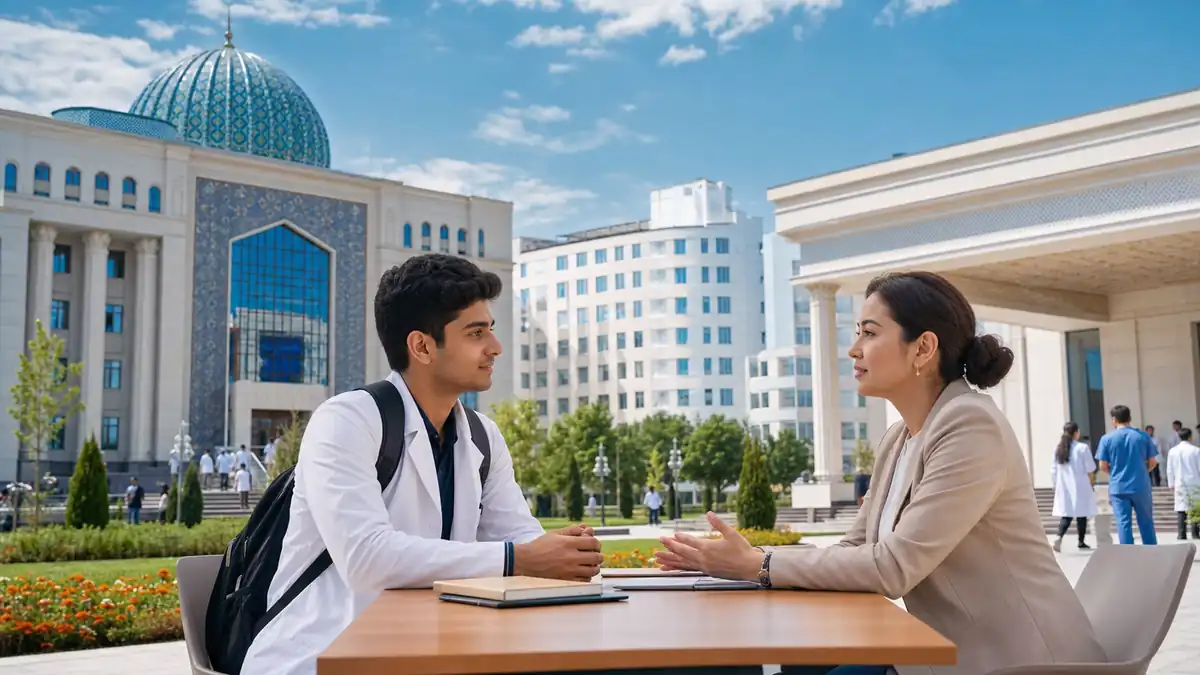
If you drew a map of where Indian medical students are actually going in 2026 — not where the glossy ads point, but where the flights are filling — Uzbekistan would be one of the brightest spots on it. The reasons are practical: government medical universities with decades of teaching history, six-year English-medium MBBS programmes, total costs starting around ₹20–25 Lakhs, a three-hour flight from Delhi, and a culture that feels unexpectedly familiar. This is the complete, honest guide to MBBS in Uzbekistan for Indian students and parents.
Why Uzbekistan Has Become a Serious MBBS Destination
Uzbekistan's medical universities are not new arrivals riding a trend. Institutions like Samarkand State Medical University and Andijan State Medical University have been training doctors since the Soviet era, and the country's flagship faculties in Tashkent anchor its national healthcare system. What changed recently is access: the government opened structured international admissions, English-medium tracks matured, and Indian students discovered that the quality-to-cost ratio here beats most alternatives.
- Government universities: the institutions Indian students join are state medical universities — not private colleges renting a hospital.
- WDOMS-listed: listed in the World Directory of Medical Schools, the baseline for NMC, ECFMG and other licensing bodies.
- Genuinely low cost: tuition of roughly US$ 3,000–6,000 per year puts the entire six-year programme within ₹20–35 Lakhs all-in.
- Proximity and comfort: direct Tashkent flights from Delhi, Indian food widely manageable, and a large, growing Indian student community.
- Safety: Uzbek cities are orderly and welcoming; parents who visit consistently return reassured.
Eligibility for Indian Students
The entry bar is accessible — which is precisely why families with NEET-qualified students and mid-range budgets look here first:
- 10+2 with Physics, Chemistry and Biology, generally 50%+ in PCB (40% for reserved categories, matching NEET eligibility norms).
- A qualifying NEET score — mandatory for NMC registration later, no exceptions. Details in our recognition and FMGE guide.
- Age 17+ at admission.
- No entrance exam, no IELTS/TOEFL — admission is document-based, usually with a short online interaction.
Course Structure: Six Years, English Medium
The MBBS-equivalent programme (General Medicine) runs six years including internship, mirroring the Indian structure: pre-clinical sciences in years one and two, para-clinical subjects in year three, hospital rotations in years four and five, and a supervised internship in year six. English-medium delivery is standard on international tracks, with Uzbek/Russian language classes in early years so you can take patient histories during clinical rotations — the same pattern you will find everywhere from Russia to Georgia.
What Does It Cost?
| Head | Per year (approx.) | Six years (approx.) |
|---|
| Tuition | US$ 3,000 – 6,000 (₹2.5 – 5 Lakhs) | ₹15 – 30 Lakhs |
| Hostel | ₹40,000 – 80,000 | ₹2.5 – 5 Lakhs |
| Food & living | ₹80,000 – 1.2 Lakhs | ₹5 – 7 Lakhs |
A realistic all-in figure for the full six years is ₹20 – 35 Lakhs depending on the university and city — roughly what a single year costs at many Indian private medical colleges. The complete rupee-by-rupee breakdown, including one-time and hidden costs, is in our Uzbekistan fee guide.
The Universities Indian Students Join
Uzbekistan's strength is a spread of established government universities across its major cities:
We compare all seven — entry profiles, fee tiers, hostel standards, Indian cohort size — in our dedicated post on the top medical universities in Uzbekistan.
Admission Timeline for 2026
Uzbekistan admits primarily for the September–October intake, and the process is refreshingly fast: applications from April, offer letters often within a week or two, invitation letters and visas over the summer, and travel in September. The step-by-step file — documents, invitation letter, visa — is covered in the admission process guide. Because admission is document-based, late applicants have more room here than in Turkey — but hostel allocation still rewards the early.
Life for an Indian Student in Uzbekistan
Three practical realities stand out. First, food: Indian messes operate at every university with a significant Indian cohort, vegetarian staples are cheap, and Tashkent has Indian grocery stores. Second, climate: a continental pattern — hot summers, cold (but not Siberian) winters, far gentler than Russia. Third, culture: Uzbek hospitality toward Indians is genuinely warm, helped by Bollywood's enduring popularity; students report feeling settled within weeks. Hostels are university-run, typically 2–4 sharing, with tightening security and curfews that most parents consider a feature, not a bug.
A Week in the Life of an Indian First-Year in Tashkent
Abstract guides rarely answer the question parents actually carry: what will my child's days look like? A typical first-year week runs Monday to Friday or Saturday, mornings in lectures and labs (anatomy dissection, physiology practicals), afternoons in smaller group classes, with local-language sessions twice a week. Evenings belong to the hostel — the Indian mess at dinner is where friendships and study groups form. Weekends mean laundry, video calls home, cricket in the courtyard when the weather allows, and shared cooking experiments that improve dramatically by December. Exams are semester-based with continuous internal assessment, so the workload is steady rather than back-loaded. By the second semester, most students describe a settled rhythm: the homesickness of October is largely gone by February, replaced by a routine that looks — deliberately — a lot like a disciplined Indian medical college.
Recognition: Practising in India Afterwards
An Uzbek MBBS is fully usable in India when NMC rules are followed: NEET qualified before joining, the complete six-year course including internship at one WDOMS-listed university, then the FMGE/NExT screening on return. Graduates are also eligible for the USMLE and other international routes. The full compliance checklist — and the FMGE preparation plan — is in our validity guide.
Frequently Asked Questions
Is Uzbekistan better than Russia for MBBS?
They are close cousins: similar teaching tradition, similar costs at the budget end. Uzbekistan wins on proximity, milder winters and faster admission; Russia offers a deeper bench of famous universities. Our Uzbekistan vs Russia comparison settles it profile by profile.
Is NEET required for MBBS in Uzbekistan?
Yes — a qualifying NEET result from your admission year's eligibility window is non-negotiable for NMC registration later.
What is the medium of instruction?
English on international tracks, with local language training for clinical communication — standard across the region.
How much does MBBS in Uzbekistan cost in total?
Plan ₹20 – 35 Lakhs all-in for six years, including tuition, hostel, food, flights and paperwork.
Is the degree from Uzbekistan valid for USMLE and other countries?
Yes — WDOMS-listed Uzbek universities make graduates eligible for ECFMG/USMLE (USA) and the UK's PLAB/UKMLA route, subject to each body's current criteria, alongside the India pathway.
When do applications open for the 2026 intake?
Files can be prepared from February–March, applications flow from April, and the safest conversion deadline is early August so the invitation letter and visa complete before the September–October session start.
Thinking seriously about Uzbekistan? Browse the universities, run it against other countries on the comparison tool, or book a free counselling session with Zenvia Education — we will match your NEET score and budget to the right Uzbek university, honestly. You can also contact us for this intake's verified fee letters.